Snake plants (often sold as Sansevieria; now commonly classified in Dracaena, like Dracaena trifasciata) are famous for surviving neglect. That is exactly why most people kill them with kindness. The main trick is simple: water only after the potting mix dries out most of the way. Not “once a week,” not “every Sunday,” and definitely not “whenever the top looks dry” by itself.
This guide walks you through easy, real-world checks that work in normal homes, plus a seasonal watering rhythm you can actually follow.
The one rule that prevents most problems
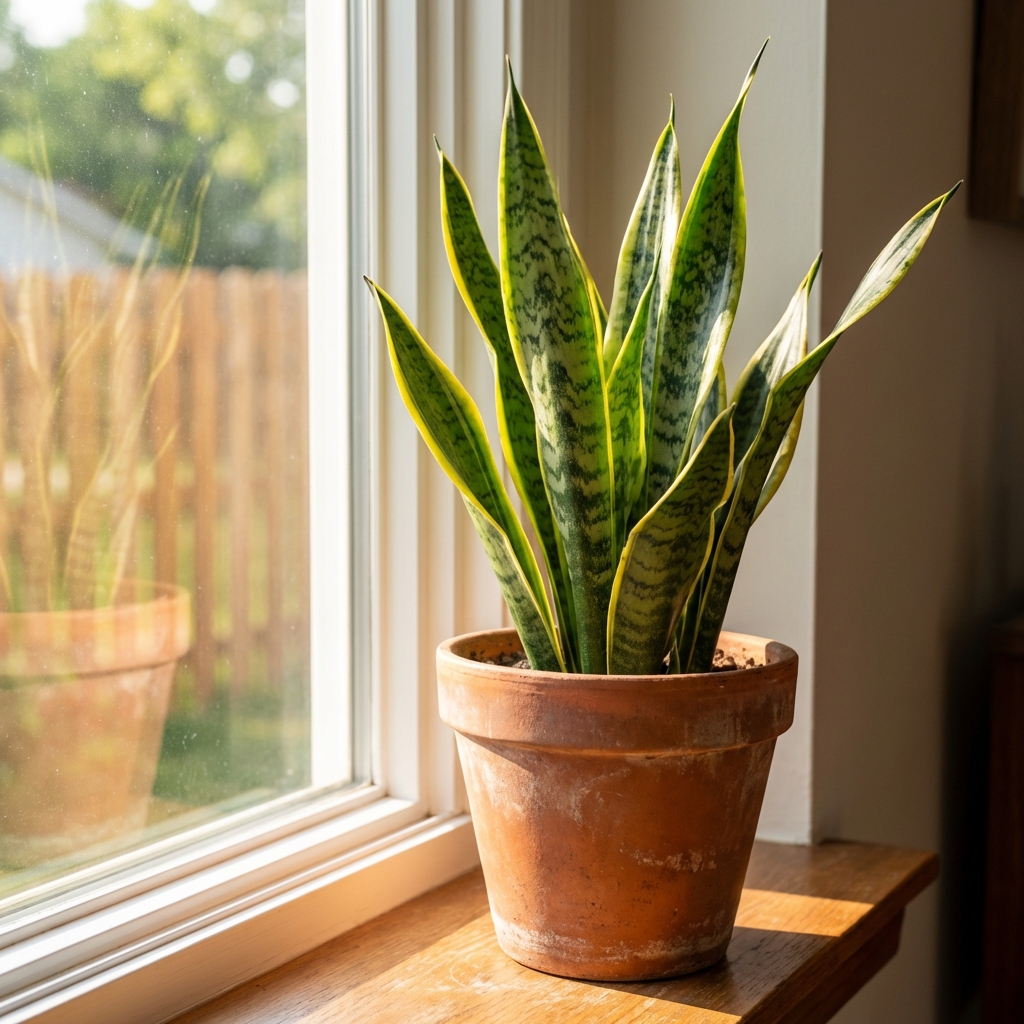
Let most of the pot dry out before watering again. In many homes, that means the mix is dry at least halfway down, and often nearly dry throughout. Snake plants store water in their thick leaves and rhizomes, so they handle dry mix far better than soggy mix.
One sentence to remember: when in doubt, wait a few more days.
- Too much water leads to root rot, mushy bases, and leaves that flop.
- Too little water usually just slows growth and causes a bit of wrinkling over time.
Quick caveat: If your plant is in very bright light, warm conditions, or a small pot that dries fast, you might water when the pot is mostly dry, not bone-dry. The checks below will keep you honest.
How to tell if it is time to water (3 beginner checks)
1) The finger test (fast and good enough)
Push a finger into the potting mix as deep as you can, ideally 2 to 3 inches. If you feel coolness or moisture, do not water.
- Water when it feels dry down where your finger reaches.
- Wait if it feels even slightly damp or cool.
Note for peat-heavy mixes: the surface can feel dry while the deeper mix is still cool and moist. Always check down, not just the top.
2) The chopstick test (best for deeper pots)
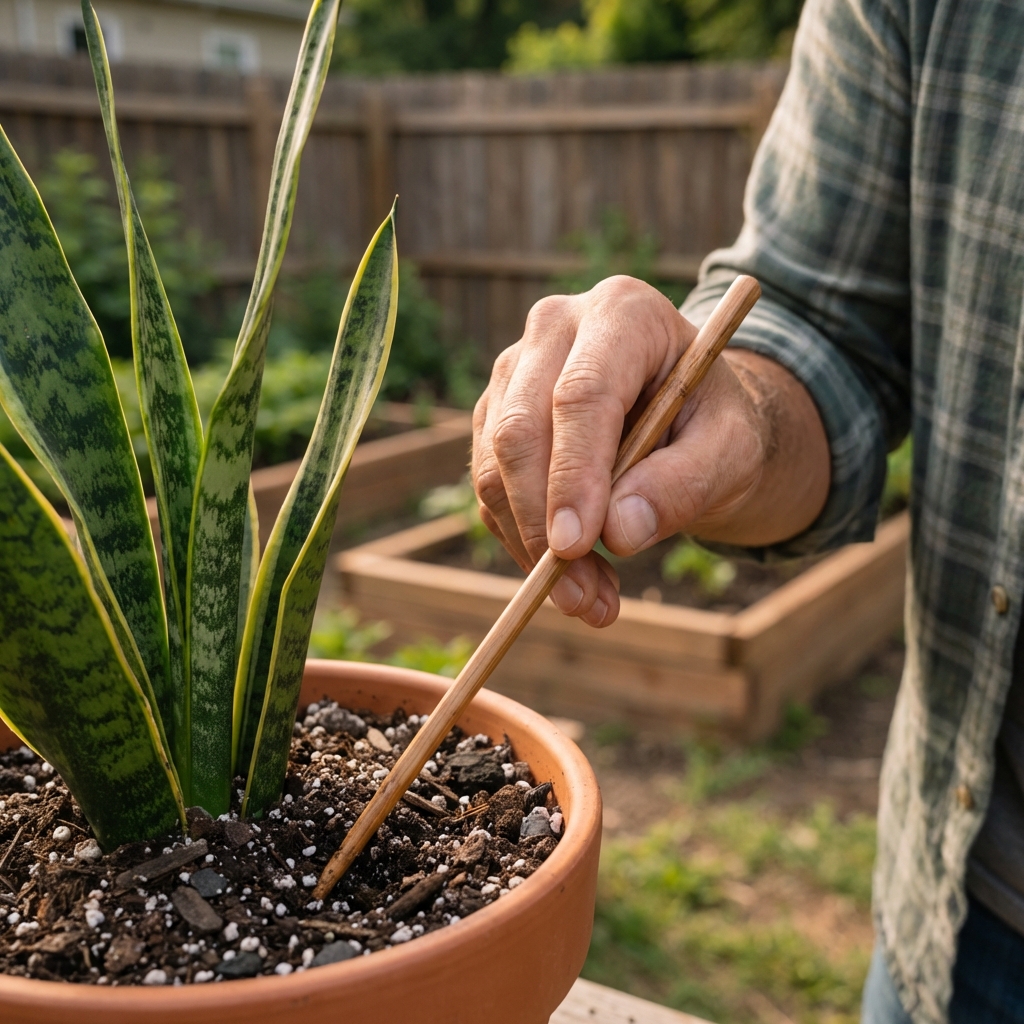
Stick a wooden chopstick or skewer straight down near the edge of the pot and leave it for 1 minute. Pull it out and look.
- Water if it comes out clean and dry.
- Wait if it comes out darker with damp mix stuck to it.
3) The pot weight test (surprisingly reliable)
Lift the pot right after a thorough watering. Feel how heavy it is. Over time, you will notice the “light as a feather” stage when it is dry enough to water again.
This is especially helpful for beginners because it does not depend on guessing what the surface looks like.
How often to water a snake plant (realistic timing)
Exact schedules do not work because light, pot type, mix, and temperature change everything. But beginners still need a starting point. Use these as ranges, then let the dryness checks above make the final call.
Typical indoor watering ranges
- Spring: every 2 to 4 weeks
- Summer: every 2 to 3 weeks (sometimes 3 to 4 if light is low)
- Fall: every 3 to 5 weeks
- Winter: every 4 to 8 weeks
If your home is cool and your plant is in medium or low light, winter can easily stretch toward the long end of that range.
Light, pot, and mix change everything
Two snake plants can sit in the same room and need different watering just because of the pot and mix.
Light level
- Bright indirect light: mix dries faster, plant uses more water, watering is a little more frequent. (A little gentle direct sun can count here.)
- Low light: mix stays wet longer, growth slows, watering should be less frequent.
Pot type
- Terracotta (clay): dries faster, more forgiving for beginners.
- Plastic or glazed ceramic: holds moisture longer, easier to overwater.
Mix
Snake plants want a mix that drains quickly. A heavy peat-based mix can stay wet in the center for a long time even if the top looks dry.
If your mix stays wet for more than 10 to 14 days in average indoor conditions, consider repotting into something chunkier, like a cactus and succulent mix, or a regular potting mix amended with perlite and orchid bark.
Extras that change watering
These are the sneaky factors that make people think they have a “mystery” watering problem.
- Temperature and HVAC: Winter heating dries air, but shorter days also slow growth. A plant near a cold window can stay wet longer even if the room feels warm.
- Pot size: A big pot for a small plant holds extra wet mix for longer. That is an overwatering trap.
- Rootbound plants: A plant packed with roots can dry faster than expected. Check more often, but still water only when mostly dry.
- Water quality and salts: Thorough watering helps flush mineral buildup. If you see a white crust on the mix or pot rim, that is often salts from tap water or fertilizer.
How to water correctly (not just when)
When it is finally time to water, do it thoroughly. Light watering can leave you with uneven moisture (wet pockets and dry pockets), and it can also concentrate salts in the pot over time.
The “soak and drain” method
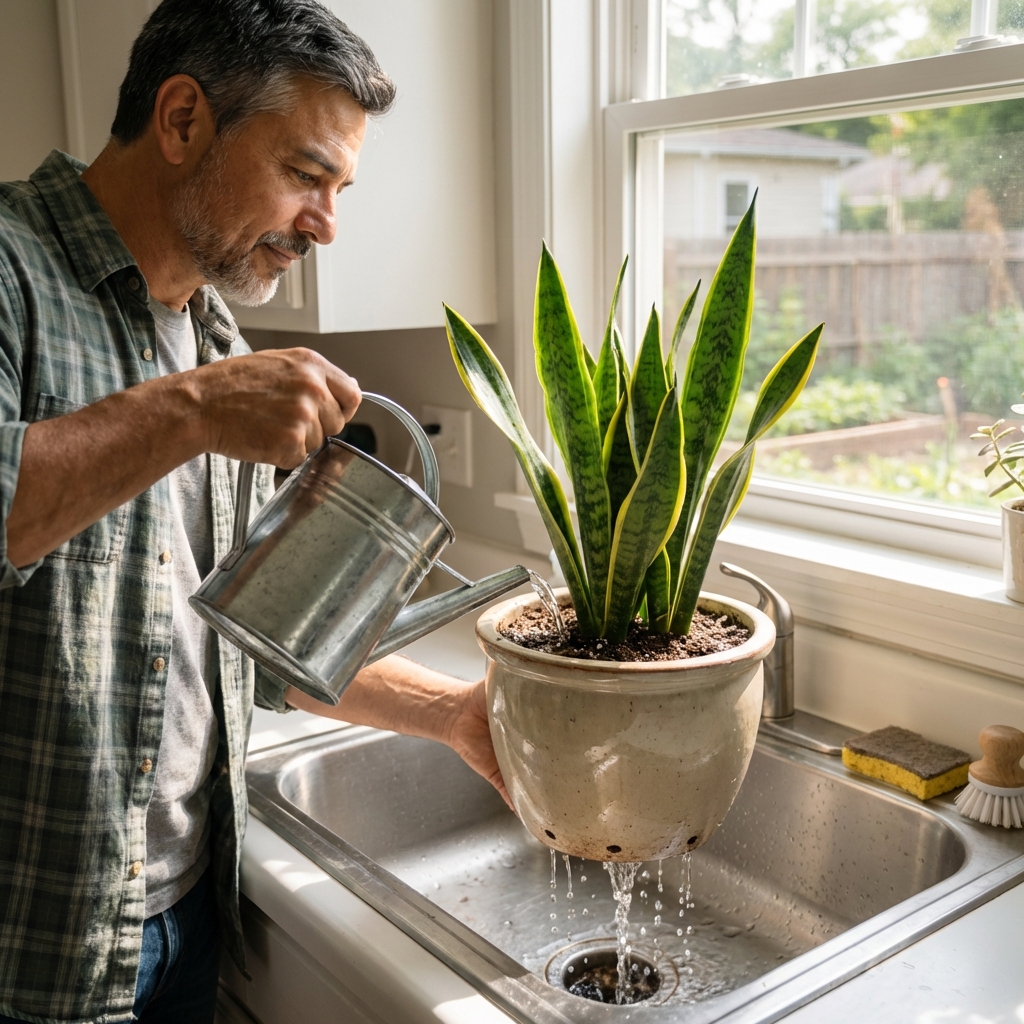
- Carry the pot to a sink, tub, or tray.
- Water slowly until water runs out of the drainage holes.
- Let it drain completely.
- Empty any saucer so the pot is not sitting in water.
Important: If your pot has no drainage hole, treat that as a temporary setup. It is much harder to water correctly without drainage, especially for beginners.
Signs you are watering too much (and what to do)
Overwatering is the most common snake plant problem. Catch it early and you can usually save the plant.
Overwatering signs
- Mix stays wet for many days
- Leaves feel soft, mushy, or look translucent near the base
- Leaves suddenly flop or fall over
- Musty smell from the pot
- Black or mushy roots if you unpot it
Quick fixes
- Stop watering and move the plant to brighter indirect light.
- Check drainage and empty the saucer.
- If the mix is soggy, unpot and inspect roots. Trim mushy roots and repot into fresh, fast-draining mix.
- After trimming rot: let any cuts dry for a few hours before repotting, and do not water immediately after repotting into dry mix. Give it about a week (longer in low light) and then resume using the dryness checks.
Signs you are underwatering (usually less serious)
Snake plants tolerate drought well, but they will eventually tell you they are thirsty.
Underwatering signs
- Leaves start to wrinkle or look slightly accordion-like
- Leaf tips dry out and turn crispy
- Potting mix pulls away from the edges and becomes very hard
- Very slow growth during the growing season (some slow-down is normal in low light)
What to do
Water thoroughly and let it drain. If the mix is extremely dry and water runs straight through, water again after 10 minutes to rehydrate the mix.
Beginner mistakes that lead to watering trouble
- Watering on a schedule: use dryness checks instead.
- Only using the surface as your cue: the top can look dry while the center is still damp.
- Only wetting the top inch: water until it drains.
- No drainage holes: easy to accidentally keep roots wet.
- Low light plus frequent watering: the classic root-rot combo.
- Big pot for a small plant: extra mix holds extra moisture for longer.
Quick DIY watering checklist
If you want a simple routine, use this every time you think, “Should I water?”
- Check the potting mix 2 to 3 inches down with a finger or chopstick.
- If it is not dry, wait 3 to 7 days and check again.
- If it is dry most of the way down, water until it drains, then empty the saucer.
- In winter, low light, or near cold windows, add extra waiting time even if you are unsure.
Snake plants reward patience. Give them bright, indirect light, fast-draining mix, and long dry spells between waterings, and they will look good with very little effort.

Jose Brito
I’m Jose Britto, the writer behind The Country Store Farm Website. I share practical, down-to-earth gardening advice for home growers—whether you’re starting your first raised bed, troubleshooting pests, improving soil, or figuring out what to plant next. My focus is simple: clear tips you can actually use, realistic expectations, and methods that work in real backyards (not just in perfect conditions). If you like straightforward guidance and learning as you go, you’re in the right place.